A few months ago, around the time when I was teaching summer school and I spent every free day I had off in the office lesson planning or in bed, I decided that when those summer classes ended I was going to make an active effort to get out and see more of Hanoi. I knew I had a whole year to check everything out, but when you only have 2 non-consecutive days off a week (or, in my first couple months, 1 day a week) and one of those is often taken up with errands or work administrivia, time moves pretty quickly and it's really up to you to get your Ferris Bueller on and look around once in a while. That being said, on a beautiful Monday/Wednesday afternoon (I don't remember but those are my days off so it was one of those), Dan I and I headed around the corner to check out the
Temple of Literature in the Đống Đa district.
Somehow I managed to visit it and NOT take a picture of the very famous front gate, from the front anyway. Here's a shot from inside.
It's actually a big complex that takes up a triangular shaped block in the city, so when you enter through the first gate this is the delightfully bucolic and peaceful sight you're met with.
Gate leading to the second courtyard.
Making our way further into the temple system. Some of the buildings were closed. This is the
Constellation of Literature Pavilion. The Temple of Literature was the first national university in Vietnam. It was part of the old
Đại Việt country, the precursor to modern Vietnam. It was built in 1070. You can find all of this on the Wikipedia page.
The "well of Heavenly Clarity" and the Stelae of the doctors,
third courtyard.
The
stelae [
n., pl., an upright stone slab or column typically bearing a commemorative inscription or relief design, often serving as a gravestone] of doctors who passed their exams and the mandarins who administered the exams.
Apparently you used to be able to rub the turtles' heads for good luck but not any more, as they are trying to preserve them. The
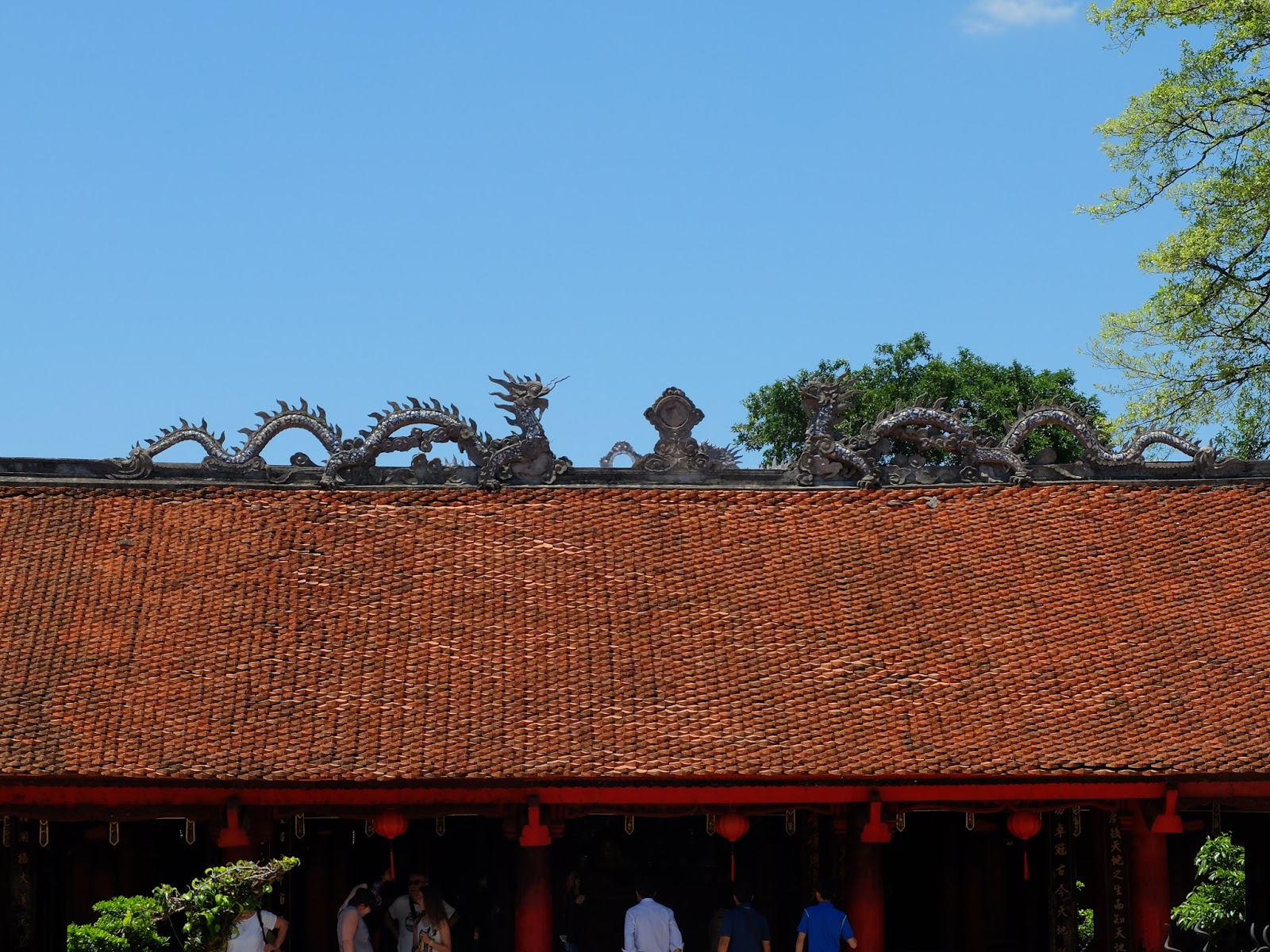
turtle is one of the four sacred animals in Vietnam and is considered very lucky (it also features heavily at the temple on Hoan Kiem which I'll write about soon, promise!). The other three animals are the
Vietnamese dragon, the
phoenix, and
the qilin (although I have also heard it described as the unicorn, I think because it's a horned creature).
The writing system predates the
change to latin characters, in the late-19th/mid-20th century.
People still actively using a religious icon/building to worship even as it is available to the general public for tourism purposes. A pretty common phenomenon in every country I've visited, but still never not fascinating, and definitely an element of tourism around Hanoi, where you can walk up to and inside pagodas where people are in the middle of prayer/leaving gifts at the altars.
In Vietnam, it really is turtles all the way down.
Behind the academy are two giant drums and giant bells, presumably meant to be beaten/rung on momentous occasions.
The back of the academy, and the edge of the park.
Circling back around to explore the inside of the academy, where there was a museum of sorts dedicated to the doctors who studied there.
Altar among the museum.
Upstairs are altars dedicated to three monarchs who contributed to the construction of the academy Lý Thánh Tông, who founded the temple in 1070, Lý Nhân Tông, who founded the academy, and Lê Thánh Tông, who ordered/organization the construction of the stelae.
From the second floor of the Imperial Academy, looking at the first building in the fifth courtyard (aka the Confucius temple where Dan stuck his head in the bell).
Heading back out, there was a pretty cool space in the front building of the academy that was devoted to cultural and educational events. Although apparently there is a daily performance, we were too late for the morning one and too early for the afternoon one.
Tiny decorative instrument filled with tinier decorative instruments.
Bonus for band.
Although most of the structures within the Temple of Literature are recreations and restorations due to heavy damage sustained over the years (notably in 1920, 1954, and 2000) it still maintains the style it was orginally built in. It's an important site for Hanoians and Vietnamese alike and the front gate is actually portrayed all over the city as its symbol, like this:
All in all, it doesn't take more than an hour or two (depending on how contemplative you're feeling, some of the shadier courtyards would definitely be a great place to bring a picnic or a book and just relax) to visit the whole thing and it's definitely worth the, like, $2 it costs to go in.
One more structure, which is actually outside Temple of Literature complex, in the parking lot, but still pretty aesthetically pleasing anyway.